INSIGHTS · ENERGY & INFRASTRUCTURE
The wattage gap: AI, electrification and the new power cycle
Photo: Basotxerri, CC BY-SA 4.0

Electricity demand is growing again in the world’s largest economies, and the scarce asset is no longer capital but deliverable megawatts: turbines, transformers and grid connections.
After roughly 15 years of flat consumption in advanced economies, electricity is a growth market again [1]. The IEA expects global demand to rise by 3.6% a year over 2026–2030, about 50% faster than the average of the previous decade [1]. Data centres get the headlines, but the bigger story is broad electrification of buildings, industry and transport. Our thesis is simple: in this cycle the binding constraints are physical, not financial, and value will accrue to whoever controls firm capacity, grid access and the equipment needed to deliver both.
Keep the hype in proportion
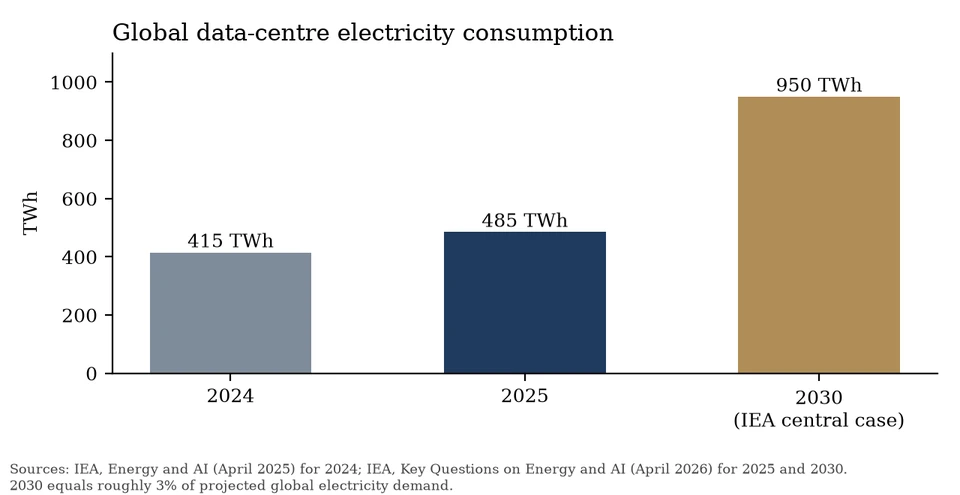
Data centres used around 485 TWh in 2025, up 17% on the year; consumption at AI-focused facilities rose by about 50% [3][4]. The IEA’s central case has data-centre demand roughly doubling to 950 TWh by 2030, which is still only about 3% of global electricity use [4]. Buildings (cooling, heat pumps and data centres included) are expected to account for 49% of global demand growth to 2030, transport’s share of growth is set to double to more than 10%, and electricity’s share of final energy consumption is forecast to rise from 21% to 24% [1].
The AI load matters because it is concentrated. In the US, data centres are expected to drive about half of demand growth to 2030 [1]. Estimates vary widely, though: Lawrence Berkeley National Laboratory put US data centres at 4.4% of national consumption in 2023 and projects 6.7–12% by 2028, a range wide enough to accommodate both bulls and sceptics [5]. Queues inflate further. Texas’s grid operator has received 180 GW of data-centre connection requests, about twice the world’s current colocation and hyperscale capacity, and the IEA notes some are speculative [6]. Queue positions are cheap; electrons are not. Efficiency is also moving: the IEA reports energy per AI task falling at an unprecedented rate, even as usage grows faster still [3].
Gas firms the system, if you can get a turbine
Orders for gas-fired plant reached 130 GW in 2025, a 25-year high, with the US and the Middle East dominating order books [6]. Manufacturers are effectively sold out. GE Vernova’s backlog and slot reservations reached 116 GW at the end of the second quarter of 2026, and it is taking reservations for 2031 delivery [8]. Siemens Energy reports 69 GW of backlog plus 26 GW of reservations, with lead times of three years or more [9]; Mitsubishi’s large-frame backlog is 35 GW [10]. In the US, orders for onsite data-centre generation reached nearly USD 14 billion in 2025, and in the first quarter of 2026 captive orders exceeded grid-connected ones [6].
Firm does not mean cheap. This year’s disruption to LNG flows through the Strait of Hormuz temporarily removed nearly 20% of global LNG supply and pushed Asian and European gas prices to their highest since 2022–23; the IEA now expects global gas-fired output to be broadly flat in 2026 [2]. Fuel exposure belongs in the underwriting case, not the footnotes.
Solar and storage are graduating to firm capacity
Solar PV is forecast to add around 600 TWh of output in 2026, matching 2025’s record, and renewables are set to overtake coal in global generation this year [2]. Power-sector battery spending is expected to exceed USD 100 billion in 2026 [6]. The price signal is visible: in the second quarter of 2026, wholesale prices rose by more than 30% year on year in the EU and Japan but fell by about 45% in Australia, where renewables and batteries reduced reliance on gas at peak [2]. Abu Dhabi offers a live test of solar-plus-storage as baseload: a 5.2 GW solar and 19 GWh battery project designed to deliver 1 GW of continuous power reached financial close in July 2026 at a total cost of USD 6.1 billion, with operation expected in 2027 [17].
Nuclear: a real option on a long fuse
Technology-company nuclear announcements exceed 50 GW, but the IEA notes that the regulatory readiness of designs varies and only one US company has NRC approval for its small modular reactor designs [6]. The IEA’s base case sees the first SMRs come online around 2030 [7]. Large reactors can be delivered: the UAE’s 5.6 GW Barakah plant, fully operational since September 2024, supplies about a quarter of the country’s electricity [18]. For this decade, investors should price SMRs as an option, not as baseload.
The grid is the bottleneck
More than 2,500 GW of renewables, storage and large-load projects are stalled in connection queues worldwide [1]. Network spending is expected to reach about USD 550 billion in 2026, up nearly 20%, although part of that rise reflects costlier transformers and cables rather than more kit [6]. Wood Mackenzie estimates US shortages of 15% for power transformers and 8% for substations in 2026, and expects new US restrictions on imported bulk-power equipment to tighten supply further [11].
Power prices: a local story
PJM, the largest US market, cleared its 2027/28 capacity auction at the USD 333.44/MW-day cap and still fell 6.6 GW short of its reliability requirement; nearly 5.1 GW of the 5.25 GW rise in forecast peak load came from data centres [12]. Yet national US retail prices have risen only from about 13 to 15 cents per kWh in real terms since 2022 [13]. The bill arrives at the substation, not in the national average, which is why large-load tariffs and cost-allocation rules now matter as much as fuel prices.
Follow the capital
Spending on data-centre IT equipment and energy reached USD 565 billion in 2025, with energy-sector investment for data-centre build-out estimated at about USD 105 billion [6]. Capital expenditure by five large technology companies exceeded USD 400 billion in 2025 and is expected to rise a further 75% in 2026 [3]. Gulf capital is active on both sides of the ledger. At home, Stargate UAE plans a 1 GW cluster with 200 MW initially expected in 2026 [14], and Reuters reported in September 2026 that the wider 5 GW UAE–US AI Campus is likely to become a network of sites across the country rather than a single campus [15]. Saudi Arabia’s Humain, according to its chief executive in May 2025, is targeting 1.9 GW by 2030 and 6.6 GW by 2034 [16]. Access to compute is licensed: in November 2025 the US Commerce Department authorised G42 and Humain to buy up to 35,000 advanced Nvidia chips, subject to security and reporting requirements [19]. Abroad, MGX and its partners closed the roughly USD 40 billion acquisition of Aligned Data Centers in July 2026 [20].
What this means for investors
First, scarcity value sits in deliverable megawatts: sites with connections, secured turbine slots and transformers. Second, contract structure matters more than technology choice; large-load tariffs, take-or-pay terms and behind-the-meter arrangements determine who bears the cost. Third, underwrite to signed offtake, not to queue-based demand forecasts. Fourth, the Gulf’s advantages in land, low-cost solar, gas and capital are real, but so are chip-licensing conditions and the cost of resilience.
Sources
- IEA, Electricity 2026, executive summary (February 2026). (opens in a new tab)
- IEA, Electricity Mid-Year Update 2026, executive summary (July 2026). (opens in a new tab)
- IEA, “Data centre electricity use surged in 2025, even with tightening bottlenecks driving a scramble for solutions”, press release (16 April 2026). (opens in a new tab)
- IEA, Key Questions on Energy and AI, executive summary (April 2026). (opens in a new tab)
- US Department of Energy, “DOE Releases New Report Evaluating Increase in Electricity Demand from Data Centers” (LBNL 2024 United States Data Center Energy Usage Report) (20 December 2024). (opens in a new tab)
- IEA, World Energy Investment 2026 (May 2026; revised June 2026). (opens in a new tab)
- IEA, Energy and AI (April 2025). (opens in a new tab)
- Utility Dive, “GE Vernova gas turbine backlog climbs to 116 GW” (July 2026). (opens in a new tab)
- Utility Dive, “Siemens Energy’s gas turbine backlog nears 70 GW as company expands manufacturing” (August 2026). (opens in a new tab)
- Utility Dive, “Mitsubishi’s large-frame gas turbine backlog reaches 35 GW” (August 2026). (opens in a new tab)
- Wood Mackenzie, “US executive order banning Chinese bulk-power equipment set to worsen critical transformer shortage” (31 August 2026). (opens in a new tab)
- PJM Interconnection, “PJM Auction Procures 134,479 MW of Generation Resources”, 2027/2028 Base Residual Auction (17 December 2025). (opens in a new tab)
- M. Cembalest, “Fighting Words: The Energy Transition in 2026”, Eye on the Market 16th Annual Energy Paper, J.P. Morgan Asset & Wealth Management (3 March 2026). (opens in a new tab)
- OpenAI, “Introducing Stargate UAE” (22 May 2025). (opens in a new tab)
- Zawya, “UAE revises 5GW AI data centre plans amid infrastructure resilience push – Reuters” (September 2026). (opens in a new tab)
- DatacenterDynamics, “Saudi Arabia’s AI co. Humain looking for US data center equity partner, targets 6.6GW by 2034” (28 May 2025). (opens in a new tab)
- Masdar, “Masdar reaches financial close for world-first US$6.1 billion gigascale 24/7 clean energy project” (13 July 2026). (opens in a new tab)
- World Nuclear News, “Barakah 4 landmark announced as World Nuclear Symposium gets under way” (5 September 2024). (opens in a new tab)
- CNBC, “U.S. greenlights AI chip exports to Gulf tech giants after Saudi Crown Prince’s Washington visit” (20 November 2025). (opens in a new tab)
- MGX, “AIP, MGX and BlackRock’s GIP Close Acquisition of Aligned Data Centers” (21 July 2026). (opens in a new tab)
Disclaimer
This article is published by Onex Holding for general information only. It is based on publicly available sources believed to be reliable as at the date of publication, which have not been independently verified. It does not constitute investment, legal, tax or other advice, or an offer or solicitation to buy or sell any security or interest. Forecasts are those of the cited sources and are inherently uncertain. Views expressed may change without notice.