INSIGHTS · ENERGY & INFRASTRUCTURE
Still the swing fuel: why gas matters for Europe and Türkiye
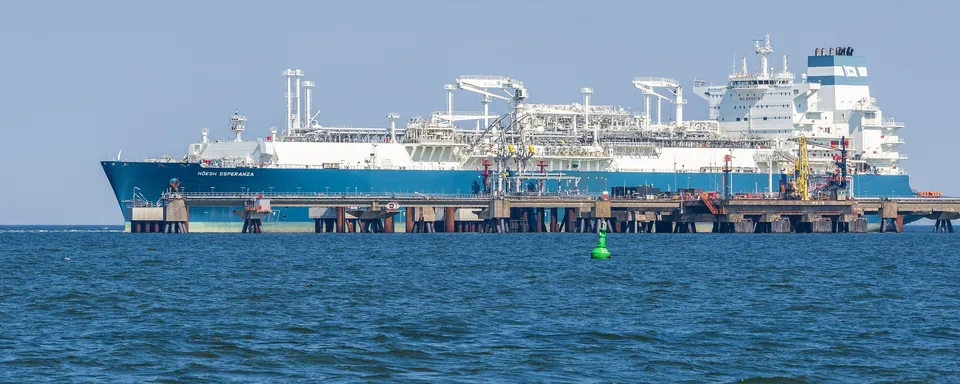
Photo: JoachimKohler-HB, CC BY-SA 4.0

Europe has replaced most of the Russian gas it used to buy, but not the flexibility that came with it, and that flexibility, along with the infrastructure that delivers it, is now the scarce and highly priced asset in Europe and Türkiye alike.
Gas is no longer Europe’s growth fuel, but it is still the system’s insurance policy. The EU used about 335 bcm a year over 2021–2025, roughly a fifth of its energy consumption. About 38% of that went to industry and 22% to power and heat generation, and most of the rest heated buildings [1]. Our thesis is that Europe has solved the volume problem created by the loss of Russian pipeline gas, but not the price or flexibility problem. Investors should look less at the molecule and more at the infrastructure that delivers flexibility: regasification, storage, interconnectors and dispatchable power. The same logic applies in Türkiye, with a larger contract cliff.
The shock absorber
As coal plants close and the share of weather-dependent renewables rises, flexible gas plants play an increasingly important balancing role, the IEA notes [2]. The summer of 2026 showed it. Heatwaves, weak hydropower and low wind lifted EU gas-fired generation by more than 10% year on year between May and September [2]. Governments are now paying for that insurance directly. In September 2026 the European Commission approved a German capacity mechanism expected to cost EUR 15.6–35.2 billion. It offers contracts of up to 15 years, requires new gas plants to be hydrogen-ready and requires capacity on 15-year contracts to be climate-neutral by 2045 [3]. The first auction sought 4.5 GW of derated capacity, drew about 12 GW of bids and cleared at an average of EUR 155,296 per MW-year, well below the EUR 244,000 cap [4]. Reliability is being bought on availability, not on energy sold.
The Russian unwind, by the numbers
EU imports of Russian pipeline gas fell from 137 bcm in 2021 to 18 bcm in 2025, a drop of 87% [1]. Including LNG, Russia’s share of EU gas imports fell from 45% in 2021 to 19% in 2024 and 12% in the first eight months of 2025 [5]. Transit through Ukraine stopped at the end of 2024, leaving TurkStream as the only remaining pipeline route for Russian gas into Europe [6]. Regulation (EU) 2026/261 now phases out the rest. Imports under contracts signed after 17 June 2025 have been banned since 18 March 2026, and imports under existing short-term contracts ended on 25 April 2026 for LNG and on 17 June 2026 for pipeline gas. Long-term contracts end on 1 January 2027 for LNG and on 30 September 2027 for pipeline gas, extendable to 1 November 2027 where storage targets are at risk [7][8]. The IEA expects this to cut Russian gas exports to the EU by about 30 bcm in 2027 compared with 2026 [2].
LNG rose from 20% to 45% of EU gas imports between 2021 and 2025, and the US supplied 58% of the EU’s LNG in 2025. Norway’s share of pipeline imports rose from 30% to 54%, with North Africa at 19% and Azerbaijan at 7% [1]. EU regasification capacity grew by 76 bcm to 242 bcm a year over the same period [1]. Europe has diversified its suppliers, but it now depends on a single mechanism, the global LNG market. That market lost almost a fifth of its supply when flows through the Strait of Hormuz were disrupted this year [2].
The price of flexibility
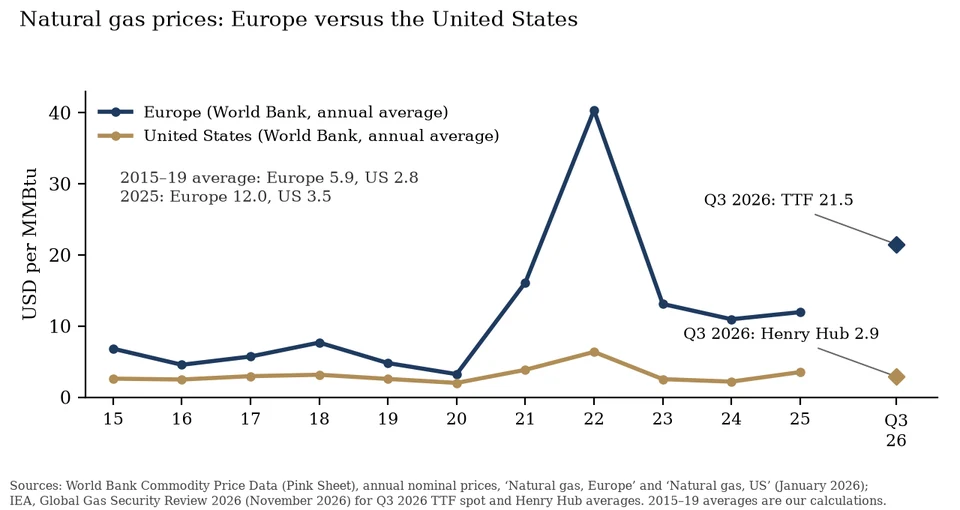
By World Bank data, European gas averaged about USD 5.9/MMBtu over 2015–2019, roughly twice the US level. In 2025 it averaged USD 12.0, about 3.4 times the US price of USD 3.5 [9]. In the third quarter of 2026, TTF spot averaged USD 21.5/MMBtu against USD 2.90 at Henry Hub [2]. Storage is where the cost shows. Regulation (EU) 2025/1733 keeps the 90% filling target to the end of 2027, but allows it to be met at any time between 1 October and 1 December and permits deviations of up to 10 percentage points [10]. With winter contracts trading below spot prices through the summer, there was little commercial reason to inject. EU storage reached only 75% and entered the heating season at its lowest level since 2013, which leaves a larger refill bill for summer 2027 [2]. Gas use in industry fell by 9% in Belgium and 6% in Italy year on year in the second and third quarters of 2026 [2], and ACER puts the EU–US gap in industrial electricity prices at twice its pre-crisis level [11]. Security has a price, and the open question is who pays it.
Türkiye: the market that grew
Türkiye consumed 59.1 bcm in 2025, up 11%. Of its 58.3 bcm of imports, 36.3% came from Russia, 20.4% from Azerbaijan, 16.2% from the US, 13.2% from Iran and 7.6% from Algeria, and LNG made up 29.3% of the total [12]. Output from the Black Sea Sakarya field lifted domestic production by 38% to 3.1 bcm [12]. The Osman Gazi floating platform is due to raise field output from about 9.5 to 20 million cubic metres a day from early 2027 [13]. Three FSRUs of 28 mcm/d each and two onshore terminals give about 161 mcm/d of regasification capacity [14]. Licensed underground storage stood at 6.3 bcm at the end of 2025 [12], against a target of 13.4 bcm by 2028 [14].
The contract calendar is the pressure point. BOTAŞ extended its Gazprom contracts, about 22 bcm a year, by only one year in December 2025, so they now expire at the end of 2026 [15]. The 9.6 bcm-a-year contract with Iran is understood to have expired in July 2026, with no successor reported by the end of October [2]. Together these cover more than half of 2025 imports, by our arithmetic. The IEA estimates that non-renewal could cut Russian deliveries to Türkiye by more than 6 bcm year on year in the first quarter of 2027 [2]. Türkiye has hedged with LNG. It was the largest single country buyer in the LNG contracts signed in 2025, at about 12 bcm a year [2], and it exported 2.3 bcm, mostly to Bulgaria [12]. Its ambition to become a hub depends on spare regasification capacity, storage and a transparent traded price.
Where the investment case sits
First, storage and regasification. The buffer has become the bottleneck, and floating units offer the flexibility to move capacity if demand falls. Second, interconnectors and the Southern Gas Corridor: TAP confirmed in March 2026 that its first expansion, 1.2 bcm a year of new long-term capacity, is fully operational [16]. Third, flexible gas-fired power under capacity contracts, where revenue comes from availability rather than volumes and hydrogen-readiness is now part of the price of entry [3]. Fourth, contract tenor needs care. A 20-year supply deal signed today runs well into the period of EU climate-neutrality targets. Rules on imports are also changing: the Commission has proposed a one-year delay to methane reporting rules for importers, and Parliament wants three [17]. New liquefaction, mainly in North America, added about 38 bcm of supply in the first ten months of 2026 [2], a wave we will cover separately. For now, the best returns lie in assets that are paid to stand ready, not in long-term bets on volumes.
Sources
- European Commission, Directorate-General for Energy, “Liquefied natural gas” (key facts and partners, accessed November 2026). (opens in a new tab)
- IEA, Global Gas Security Review 2026, including the Gas Market Report Q4-2026 (November 2026). (opens in a new tab)
- European Commission, “Commission approves German capacity mechanism of up to €35 billion to secure electricity supply”, press release IP/26/1778 (2 September 2026). (opens in a new tab)
- Bundesnetzagentur, “StromVKG – Ergebnisse der ersten Ausschreibung für Langzeitkapazitäten” (3 November 2026). (opens in a new tab)
- European Commission, State of the Energy Union Report 2025, COM(2025) 667 (6 November 2025). (opens in a new tab)
- Oxford Institute for Energy Studies, “No Way Back? Challenges to Russian Pipeline Gas in Europe Make Near-Term Rebound Unlikely”, OIES Energy Insight 166 (March 2025). (opens in a new tab)
- Regulation (EU) 2026/261 on phasing out Russian natural gas imports, Official Journal of the EU (2026). (opens in a new tab)
- ACER, Report on Russian gas import contracts and diversification (2026). (opens in a new tab)
- World Bank, Commodity Price Data (The Pink Sheet), annual prices, nominal US dollars (updated 6 January 2026). (opens in a new tab)
- Regulation (EU) 2025/1733 amending Regulation (EU) 2017/1938 as regards the role of gas storage (18 July 2025). (opens in a new tab)
- ACER, Key developments in European electricity and gas markets – 2026 Monitoring Report (March 2026). (opens in a new tab)
- EPDK (Energy Market Regulatory Authority of Türkiye), Natural Gas Market Sector Report 2025 (published 26 June 2026). (opens in a new tab)
- Anadolu Agency, “Türkiye to double Black Sea gas output with first floating production platform” (15 October 2026). (opens in a new tab)
- Anadolu Agency, “Doğal gaz depoları, FSRU ve LNG tesisleri Türkiye’nin arz güvenliğinde stratejik rol üstleniyor” (18 June 2025). (opens in a new tab)
- Reuters, “Turkey extends Russian gas imports for a year as it plans US investment” (4 December 2025). (opens in a new tab)
- Trans Adriatic Pipeline, “TAP strengthens natural gas deliveries to Europe” (4 March 2026). (opens in a new tab)
- European Parliamentary Research Service, “Amending the Methane Regulation: Postponement of certain obligations” (updated 29 October 2026). (opens in a new tab)
Disclaimer
This article is published by Onex Holding for general information only. It is based on publicly available sources believed to be reliable as at the date of publication, which have not been independently verified. It does not constitute investment, legal, tax or other advice, or an offer or solicitation to buy or sell any security or interest. Forecasts are those of the cited sources and are inherently uncertain. Views expressed may change without notice.